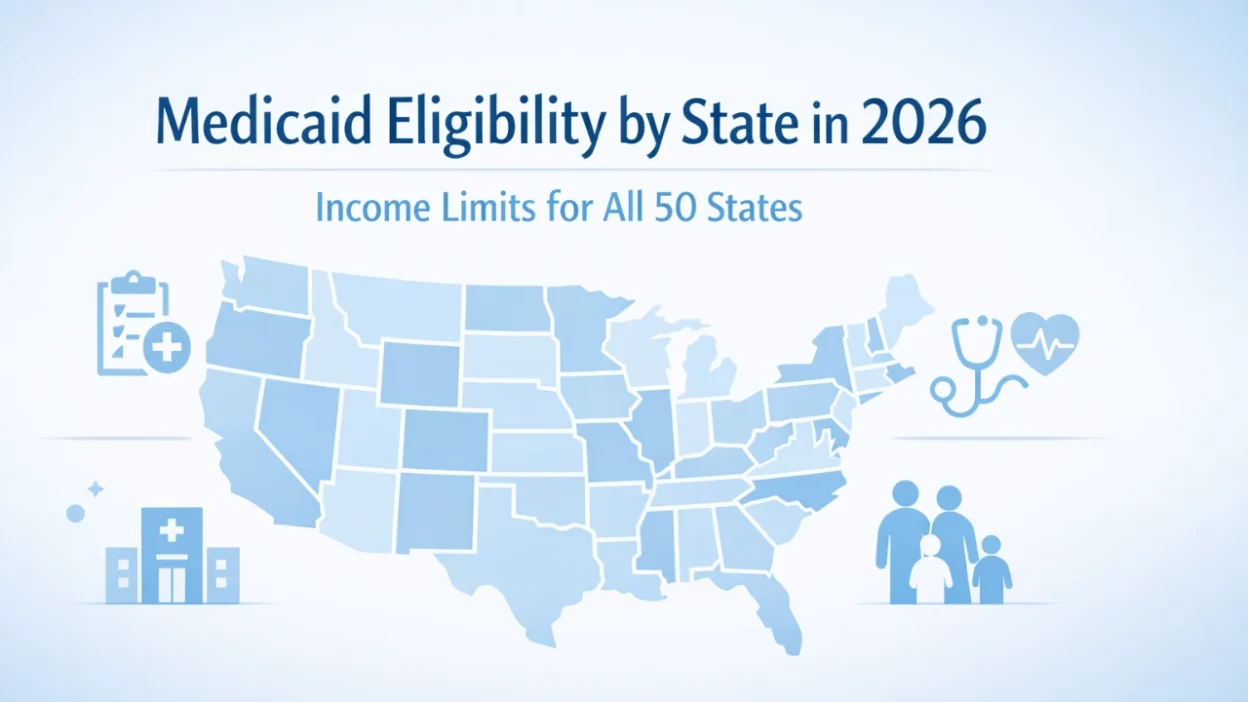
If you want to find out Medicaid eligibility by state in 2026, here’s the simple truth:
It depends on:
- The state you live in
- How much money your household makes
- Your situation (adult, child, pregnant, senior, disabled)
Medicaid is authorized by each state but overseen by the Centers for Medicare & Medicaid Services (CMS). That’s why policies are different in Texas vs California and Florida.
What Is Medicaid and Why Expansion Matters
Medicaid is government health insurance for people with lower income.
It helps pay for:
- Doctor visits
- Hospital care
- Prescriptions
- Pregnancy care
- Long-term care for seniors
Under the Affordable Care Act (ACA), states were allowed to “expand” Medicaid.
What does expansion mean?
In most expansion states:
- Adults can eligible if they earn up to 138% of the Federal Poverty Level (FPL).
In non-expansion states:
- Adults without children usually don’t eligible at all, even if they’re very low income.
That difference is huge.
2026 Federal Poverty Level (FPL) Overview
Medicaid uses something called the Federal Poverty Level (FPL) to finalize who eligible.
Here’s a simple example:
| Household Size | 100% FPL | 138% FPL (Expansion Adult Limit) |
| 1 person | $15,000 | $20,700 |
| 2 member | $20,000 | $27,600 |
| 4 person | $31,000 | $42,800 |
So if you are only one and make around $20,000 per 12 months in an expansion state, you likely eligble.
Income limits update every year, so always from your state.
Medicaid Expansion vs Non-Expansion States (2026)
Expansion States (Adults ≤138% FPL)
These states expanded Medicaid:
- Alaska
- Arizona
- Arkansas
- California
- Colorado
- Connecticut
- Delaware
- Hawaii
- Illinois
- Indiana
- Iowa
- Kentucky
- Louisiana
- Maine
- Maryland
- Massachusetts
- Michigan
- Minnesota
- Missouri
- Montana
- Nebraska
- Nevada
- New Hampshire
- New Jersey
- New Mexico
- New York
- North Carolina
- North Dakota
- Ohio
- Oklahoma
- Oregon
- Pennsylvania
- Rhode Island
- South Dakota
- Vermont
- Virginia
- Washington
- West Virginia
In these states, low-income adults without kids can usually qualify.
Non-Expansion or Limited Expansion States
- Alabama
- Florida
- Georgia (Pathways program with work rules)
- Kansas
- Mississippi
- South Carolina
- Tennessee
- Texas
- Wisconsin (partial expansion)
- Wyoming
- Utah (special waiver model)
- Idaho (expanded with conditions)
In these states:
- Childless adults may not qualify at all.
- Parents must earn very little to qualify.
- Many people fall into something called the coverage gap.
Texas and Florida are the biggest non-expansion U.S states.
Medicaid Eligibility by State (All 50 States Snapshot)
Here’s a simple overview:
| State | Expansion Status | Adult Income Limit | Notes |
| Alabama | No | Very limited | Parents only |
| Alaska | Yes | 138% FPL | Full expansion |
| Arizona | Yes | 138% FPL | Standard |
| Arkansas | Yes | 138% FPL | Private model |
| California | Yes | 138% FPL | Called Medi-Cal |
| Colorado | Yes | 138% FPL | Expanded |
| Connecticut | Yes | 138% FPL | Expanded |
| Delaware | Yes | 138% FPL | Expanded |
| Florida | No | Limited | Large coverage gap |
| Georgia | Partial | Work rules | Pathways program |
| Hawaii | Yes | 138% FPL | Expanded |
| Idaho | Conditional | 138% FPL | With oversight |
| Illinois | Yes | 138% FPL | Expanded |
| Indiana | Yes | 138% FPL | HIP program |
| Iowa | Yes | 138% FPL | Expanded |
| Kansas | No | Limited | No expansion |
| Kentucky | Yes | 138% FPL | Expanded |
| Louisiana | Yes | 138% FPL | Expanded |
| Maine | Yes | 138% FPL | Expanded |
| Maryland | Yes | 138% FPL | Expanded |
| Massachusetts | Yes | 138% FPL | Generous rules |
| Michigan | Yes | 138% FPL | Healthy Michigan |
| Minnesota | Yes | 138% FPL | Includes MinnesotaCare |
| Mississippi | No | Very limited | Strict |
| Missouri | Yes | 138% FPL | Expanded |
| Montana | Yes | 138% FPL | Expanded |
| Nebraska | Yes | 138% FPL | Expanded |
| Nevada | Yes | 138% FPL | Expanded |
| New Hampshire | Yes | 138% FPL | Expanded |
| New Jersey | Yes | 138% FPL | Expanded |
| New Mexico | Yes | 138% FPL | Expanded |
| New York | Yes | 138% FPL | Essential Plan option |
| North Carolina | Yes | 138% FPL | Recently expanded |
| North Dakota | Yes | 138% FPL | Expanded |
| Ohio | Yes | 138% FPL | Expanded |
| Oklahoma | Yes | 138% FPL | Expanded |
| Oregon | Yes | 138% FPL | Expanded |
| Pennsylvania | Yes | 138% FPL | Expanded |
| Rhode Island | Yes | 138% FPL | Expanded |
| South Carolina | No | Limited | No expansion |
| South Dakota | Yes | 138% FPL | Voter approved |
| Tennessee | No | Very limited | No expansion |
| Texas | No | Extremely limited | Big coverage gap |
| Utah | Modified | ~138% FPL | Special rules |
| Vermont | Yes | 138% FPL | Expanded |
| Virginia | Yes | 138% FPL | Expanded |
| Washington | Yes | 138% FPL | Apple Health |
| West Virginia | Yes | 138% FPL | Expanded |
| Wisconsin | Partial | 100% FPL | Hybrid model |
| Wyoming | No | Limited | No expansion |
Eligibility Categories Explained
1. Adults (19–64)
If your state expanded Medicaid:
- You likely qualify at or below 138% FPL.
If not:
- You usually must be a parent with very low income.
2. Children
Children often eligible at higher income levels through Medicaid or the Children’s Health Insurance Program (CHIP).
Some states cover kids up to 200–300 percent of FPL.
3. Pregnant Individuals
Many states allow higher income limits for pregnancy coverage.
4. Seniors (65+) and Disabled
This is different.
Seniors may need to pass:
- An income test
- An asset test (savings limits)
This is separate from Medicare, which most people get at age 65.
How to Check Medicaid Eligibility in Your State
Here’s how to figure it out:
Step 1: Add Up Your Income
Include:
- Job income
- Side hustle money
- Unemployment benefits
This is called MAGI (Modified Adjusted Gross Income).
Step 2: Compare to FPL
Check your household size.
If you’re single in an expansion state and earn under about $20,700 — you likely qualify.
Step 3: Apply
You can apply at:
- HealthCare.gov
- Your state Medicaid website
- A local Medicaid office
In major cities like New York City, Los Angeles, Chicago, Houston, or Miami, you can also find in-person support.
Coverage Gap Warning
If you live in:
- Texas
- Florida
- Mississippi
- Alabama
And your income is very low but your state didn’t expand Medicaid, you may not qualify — and you may also not qualify for Marketplace help.
That’s called the coverage gap.
Medicaid vs Marketplace Insurance
| Medicaid | Marketplace Plan |
| Usually $0 premium | Subsidized plans |
| Very low copays | Varies |
| Income ≤138% FPL (expansion states) | Higher income levels |
| Asset limits only for seniors | No asset limits |
If you don’t qualify for Medicaid, check Marketplace plans.
Renewal & Redetermination in 2026
Every year, states check if you still qualify.
If your income goes up:
- You must report it.
- You might move to a Marketplace plan.
Always update your contact info so you don’t lose coverage by mistake.
Official & Helpful Resources
- Medicaid Official Information – CMS
- Health Insurance Marketplace (Apply & Eligibility)
Helpful Guides
FAQs – Medicaid Income Guidelines 2026
1. What is the adult Medicaid income limit in 2026?
In most expansion states, adults eligible at or below 138 percent of the Federal Poverty Level.
2. Which states did not expand Medicaid?
Texas, Tennessee, Wyoming, Florida, Alabama, Mississippi, Kansas, and South Carolina.
3. Can I qualify if I work part-time?
Yes. It’s about income level, not job type.
4. Does Medicaid check bank accounts?
Only seniors 60 plus and long term care applicants face asset limits. Regular adult Medicaid usually does not check.
5. How long does approval take?
Usually 30–45 days.
6. Is Medicaid different in every state?
Yes. Each state have its own income limits within federal guidelines.
7. Can I have both Medicare and Medicaid?
Yes. That’s called dual eligibility.
8. What happens if my income increases?
You must report it. You may switch to a Marketplace plan.
Conclusion
Medicaid eligibility by state in 2026 mostly comes down to:
- Where you live
- How much you earn
- Your age or situation
If your state expanded Medicaid and your income is under 138% FPL, you likely qualify.
If your state didn’t expand, eligibility is much stricter.
Your next step:
- Check your income.
- Confirm your state’s expansion status.
- Apply online or visit a local Medicaid office.
Healthcare coverage depends heavily on your state — so always verify your state’s current rules before applying.